Master handwoven bag quality control. Learn to distinguish natural raffia and straw variations from real defects, sample approval checklist & bulk QC briefs.
01 — Why Handwoven Bags Need Different Quality Standards
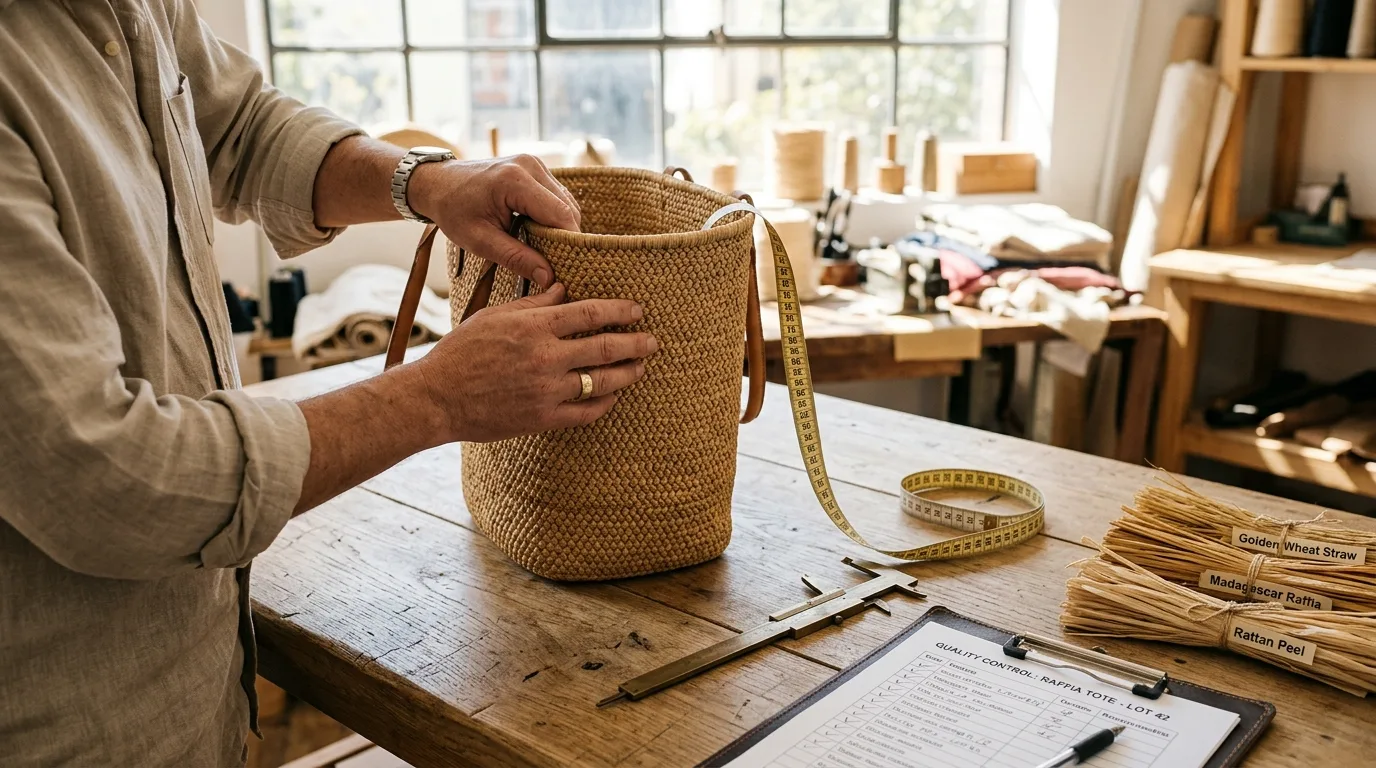 Figure 1: Precision meets craft — A quality control inspector verifies rim circumference, gauge density, and botanical fiber references against a technical brief in the NOLVA workshop.
To build an effective inspection protocol, sourcing teams must first understand why handwoven bag manufacturing cannot be evaluated through the same lens as machine-stitched leather or mass-produced nylon goods.
Authentic handwoven bags occupy a unique intersection of two organic variables: wild harvest botanical materials and human biomechanical craftsmanship.
┌────────────────────────────────────────────────────────────────────────┐
│               The Dual Organic Nature of Handwoven Goods               │
├──────────────────────────┬─────────────────────────────────────────────┤
│ 1. Botanical Fiber Botany│ Sunlight, rainfall, and harvest cycles alter│
│                          │ fiber flexibility, tensile strength & tone  │
│ 2. Manual Biomechanics   │ Artisans weave over wooden blocking molds;  │
│                          │ tension reflects human touch, not robotics  │
│ 3. The Quality Standard  │ Protect structural integrity & functionality│
│                          │ while celebrating organic material soul     │
└──────────────────────────┴─────────────────────────────────────────────┘
1. Organic Fiber Behavior Across Harvest Seasons
Unlike synthetic polyester filament extruded from a heated nozzle at an invariant 0.45 mm gauge, natural fibers are harvested from living plants:
- Madagascar Raffia (Raphia farinifera): Stripped from palm fronds and dried under equatorial sunlight. Fibers harvested during the monsoon season carry higher natural moisture content and greater pliability, whereas dry-season harvests exhibit a crisper, more golden texture. A single raffia blade naturally tapers from a wider base to a delicate tip.
- Natural Wheat & Barley Straw: Stems vary in wall thickness depending on soil mineral composition and weather conditions during grain ripening.
- Rattan & Wicker Peel: Cane flexibility depends on core density and drying kiln temperature.
Because these raw fibers undergo solar drying rather than synthetic autoclaving, subtle gradients in color, grain texture, and fiber width are physical realities of the material, not manufacturing oversights.
2. Manual Weaving and Ergonomic Rhythm
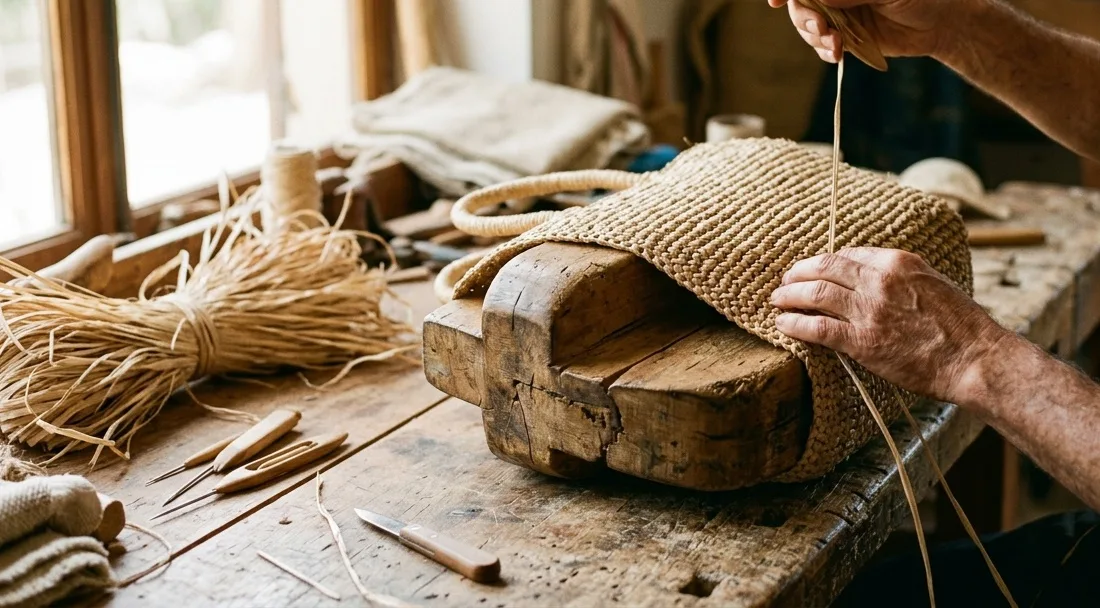
When an artisan weaves a bag, they manipulate natural fibers over a hand-carved wooden blocking mold (forme de tissage). Tension is maintained purely through manual dexterity, finger grip, and muscle memory.
- Over a standard 8-hour shift, an artisan's tension naturally micro-calibrates between morning and late afternoon.
- Two master artisans working side-by-side on the exact same tech pack will produce bags with imperceptible differences in stitch density (e.g., 8.5 stitches per 5 cm vs. 9 stitches per 5 cm).
3. Establishing a "Commercial Tolerance" Mindset
In high-volume machine bag making, a ±2 mm tolerance is standard. In artisanal handwoven bag manufacturing, enforcing a ±2 mm tolerance will result in a 95% scrap rate and skyrocketing unit costs.
A realistic, commercially viable standard for handwoven bag quality control allows for reasonable dimensional tolerances (typically ±10 mm to ±15 mm for small to medium silhouettes, and ±20 mm for oversized market totes) while maintaining zero tolerance for functional failures such as structural unraveling, loose handle anchors, or snagging hardware.
02 — Natural Variations vs. Actual Defects (The Comparative Matrix)
To eliminate ambiguity between your brand’s QC inspectors and factory floor supervisors, every checkpoint must be categorized into Acceptable Natural Variation, Conditional Tolerance, or Definite Quality Defect.
The following matrix serves as an authoritative industry reference for classifying straw bag defect classification and raffia bag quality standards:
| Inspection Checkpoint | Acceptable Natural Variation (Pass) | Conditional Tolerance (Review Required) | Unacceptable Quality Defect (Immediate Reject) |
|---|---|---|---|
| Color & Tone Consistency | Subtle tonal graduation across strands; natural straw golden highlights; soft ombre effect from solar drying. | Minor dye-lot shade shift between distinct production runs within ±1 Pantone shade (must be uniform within each carton). | Harsh blotchy dye stains; bleeding color when rubbed with a damp white cloth; dark mold stains or mildew discoloration. |
| Fiber Width & Surface Texture | Natural variation in blade width (e.g., 4 mm–7 mm across raffia strands); natural fibrous fuzziness on unpolished raw straw. | Isolated strand with minor surface dryness that does not compromise structural tensile integrity. | Severely cracked, brittle, or split fibers that break when flexed; rough burrs that snag delicate silk or linen clothing. |
| Fiber Splicing & Joints | Spliced fiber ends neatly tucked into the interior wall of the weave, trimmed cleanly to 8–10 mm and secured. | Spliced end visible on the bag exterior but under 3 mm in length and firmly locked into the surrounding weave pattern. | Loose, unknotted fiber ends unraveling on the exterior; spliced ends pulling out under light finger tension (<1.5 kg). |
| Silhouette & Base Flatness | Organic curve tolerance within ±10–15 mm; slight handwoven flexibility when resting empty on a flat glass surface. | Bag leans slightly when completely empty, but stabilizes perfectly flat once packed with a light 500g load. | Severe body twist or warping; asymmetrical rim height (>20 mm variance); base rocks or tilts over 25° when empty. |
| Weaving Tension & Density | Slight natural gauge variation (±5%) inherent to hand tensioning; consistent overall pattern fidelity. | Localized openwork gap within 1.5× the standard weave spacing that does not expose interior contents or lining. | Loose, sagging weave rows; gaping structural holes; unraveling chain stitches; visible gaps along corner stress points. |
| Handle Attachment & Anchors | Subtle variance in hand-stitched saddle thread spacing (±1 mm) on leather handle patches. | Handle drop height variation within ±10 mm between front and rear handles. | Loose or missing handle rivets; broken stay-stitches; handle anchor tearing loose under a 10 kg pull test; raw screw ends. |
| Odor & Moisture Content | Clean, fresh, earthy botanical scent characteristic of dried raffia, sun-cured straw, or vegetable-tanned leather. | Faint drying room odor that dissipates completely after 24 hours of standard room ventilation. | Pungent sour odor; damp or musty mildew smell; heavy petroleum, chemical solvent, or toxic adhesive fumes. |
┌────────────────────────────────────────────────────────────────────────┐
│                   QC Decision Rule of Thumb                            │
├────────────────────────────────────────────────────────────────────────┤
│ • If it is a natural characteristic of the plant fiber → PASS          │
│ • If it affects aesthetics without compromising durability → CONDITIONAL│
│ • If it impacts durability, user safety, or garment protection → REJECT│
└────────────────────────────────────────────────────────────────────────┘
03 — Six Things Buyers Should Check Before Approving a Sample
Before greenlighting a sample for bulk purchase order execution, brand developers must conduct a rigorous pre-production sample evaluation. Use this six-point handwoven bag inspection protocol to validate your golden sample:
1. Dimensional Proportions and Flat Stance
Place the unpadded sample on a dead-flat marble or glass table and inspect from eye level:
- Critical Height / Width / Depth: Measure against the approved technical design sheet (tech pack). Verify whether the overall silhouette conforms to approved dimensional limits (acceptable baseline: ±1.5 cm for medium totes).
- Rim Opening Circumference: Measure the top opening aperture. Ensure the opening is symmetrically oval or rectangular, rather than warped or lopsided.
- Base Flatness & Center of Gravity: Verify that the bag sits upright without tumbling forward or backward when placed on a table unassisted.
2. Weave Density and Structural Memory
Gently squeeze the side walls of the bag and release:
- Resilience & Structural Memory: High-quality handwoven bags should bounce back into their original architectural silhouette without permanent indentation.
- Gauge Consistency: Count the stitches or braids per 10 cm block across three distinct zones: near the base, the center body, and the upper collar. Excessive density drift indicates an artisan rushing through the upper rows.
- Bottom Corner Reinforcement: Examine the four bottom corners. Corners absorb the highest impact during daily wear; ensure the weave transitions smoothly around corners without thinning out.
3. Handle Anchorage and Joint Tensile Integrity
The handle junction is the single most common failure point in all consumer bags:
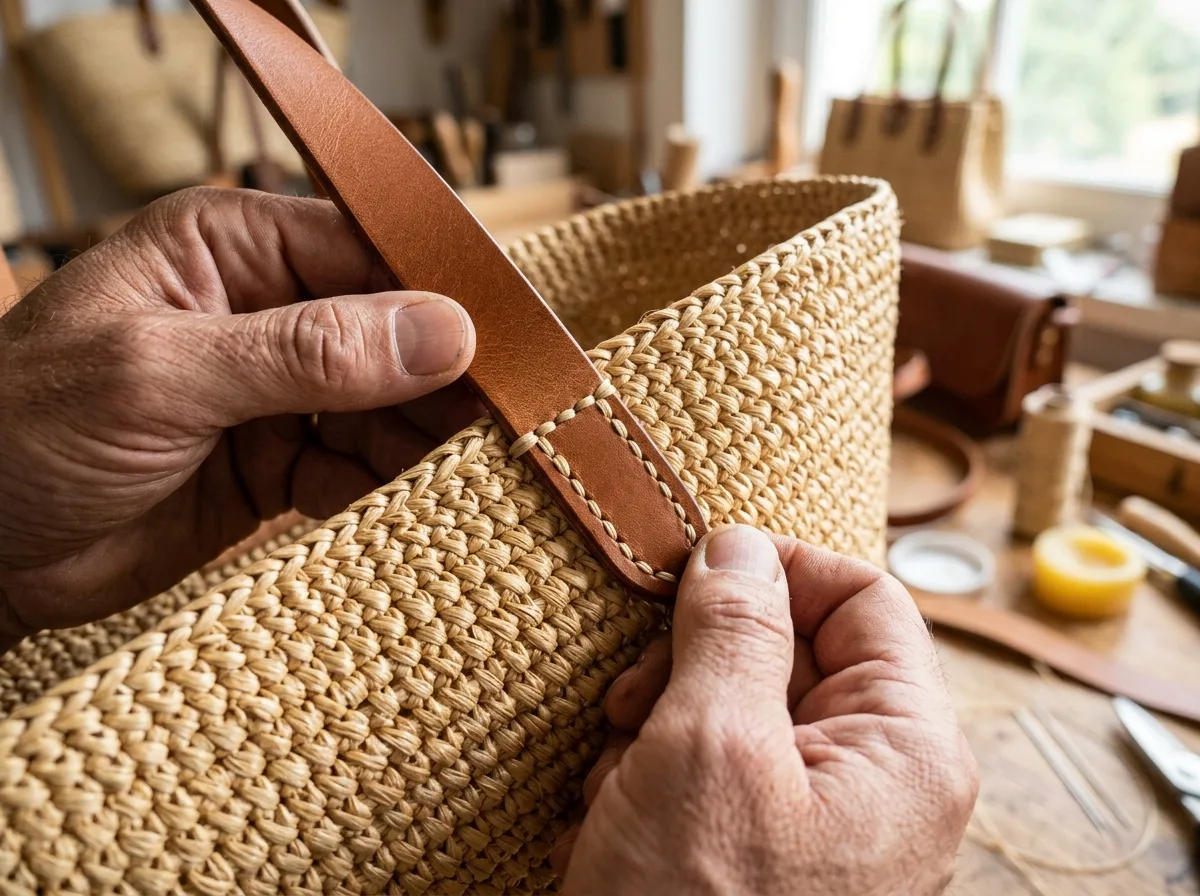 Figure 2: Stress-testing handle joints — Macro inspection of double-saddle stitching and reinforced leather anchor integrated seamlessly into the handwoven basket body.
- Anchor Construction: Does the handle connect via hand-tied fiber loops, metal grommets, or stitched leather patches? For heavy market totes, leather handle tabs should be backed by internal reinforcement washers or secondary woven stay-pads inside the bag wall.
- Handle Pull Stress Test: Secure the base of the bag and apply a firm manual vertical pull (equivalent to 12–15 kg of force) on each handle for 30 seconds. Listen for popping fiber sounds or tearing stitches. A properly constructed anchor will show zero deformation.
- Ergonomic Drop Height: Measure the vertical drop from the apex of the strap to the top edge of the bag rim. A shoulder tote requires a minimum 24–28 cm drop to clear winter coats and resort swimwear comfortably.
4. Lining, Pockets, and Zipper Gliding
A high-end handwoven exterior deserves an equally refined interior:
- Lining Clearance: When operating a metal or coil zipper, ensure the fabric lining and nearby straw strands do not catch in the zipper teeth. The lining must be anchored tautly to the bag rim.
- Drawstring Pouch Functionality: If utilizing an interior canvas or linen drawstring pouch, verify that cords slide smoothly through grommets without binding, and that drawstring knot ends are cleanly finished with metal aglets or folded stitching.
- Internal Pocket Depth: Measure interior drop pockets to ensure modern smartphones (e.g., iPhone 15 Pro Max / 16 Plus) fit without preventing the bag closure from latching.
5. Hardware, Metal Trims, and Brand Markings
- Corrosion & Salt-Spray Resistance: Because straw and raffia bags are primarily used in coastal, resort, and summer environments, all metal hardware (buckles, D-rings, magnetic snaps, studs) must feature high-grade electroplating with protective lacquer coats to prevent green verdigris and coastal saltwater corrosion.
- Debossed Leather Brand Patches: Inspect debossing clarity on brand logos. Lettering must be razor-sharp, centered within ±1 mm of the patch perimeter, and free of heat-burn scorching on vegetable-tanned leather.
- Edge Burrs: Run your fingertips along all metal edges and rivet heads to ensure zero sharp burrs that could cut skin or snag garments.
6. Static Load-Bearing and Real-World Wear Testing
Never approve a sample solely on visual aesthetics. Conduct functional physical testing:
- 24-Hour Static Load Test: Load the bag with 5 kg of evenly distributed weights (e.g., steel shot bags or books) and hang it from a hook by its handles for 24 hours at standard room temperature.
- Inspection Post-Test: Check for handle elongation, sagging base distortion, fiber tear around anchor points, or compromised seam stitching.
- Garment Friction Check (Chafing Test): Rub the exterior surface of the bag against a swatch of fine silk or white cotton jersey 50 times under moderate hand pressure. Verify that no raw fibers snag the fabric and no dyed fibers transfer color onto the cloth.
04 — How to Keep Bulk Production Consistent
Approving a flawless golden sample is only the first milestone. The true test of handwoven bag manufacturing is producing 500 or 1,000 units where the 500th bag mirrors the approved master sample.
To safeguard against bulk quality drift, successful procurement teams partner with an experienced small batch woven bag manufacturer and enforce the following five production governance mechanisms:
[Approved Golden Sample] ──► [Carved Wooden Molds] ──► [Single Dye-Lot Fiber] ──► [Line-Balancing QC]
       (Dual Sign-off)             (Shape Locking)            (Delta-E Matching)         (Inline Audits)
1. The Dual Sealed Master Sample Protocol
Never rely on digital photographs or CAD renderings for bulk quality sign-off. When the pre-production sample is approved:
- The workshop creates two identical counter-samples.
- Both samples are signed, dated, and tagged with matching tamper-evident security seals.
- Sample A remains at the buyer's headquarters as the benchmark for final receiving audits.
- Sample B is permanently displayed on the master workshop floor in a protective acrylic case, serving as the daily visual reference for artisan team leaders.
2. Standardized Wooden Blocking Molds (Formes de Tissage)
In an unorganized cottage workshop, weavers shape bags freehand, resulting in wild silhouette discrepancies. In an industrial artisan facility like NOLVA:
- Dedicated master carpenters carve identical wooden blocking molds for each SKU.
- Artisans weave the fiber tightly over these precision wooden forms, locking the base perimeter, taper angles, and rim circumference into uniform alignment across every unit in the production batch.
3. Raw Material Dye-Lot Batch Reservation
Color shading is the #1 reason for retail lot rejection in dyed raffia and straw bags.
- Raw botanical fibers must be procured and dyed in a single consolidated vat run for the entire purchase order volume, plus a 15% fiber buffer for waste and sampling.
- Dividing a 300-piece order across two separate dyeing batches weeks apart will inevitably create visible Delta-E color differences.
4. Swatch Card Archiving with Tolerance Bands
Create physical "Approved Swatch Cards" containing:
- Acceptable minimum and maximum fiber thickness ranges.
- Master approved color strands alongside acceptable ±0.5 tone variance samples.
- Approved handle leather cuttings and thread color bobbins.
5. In-Line Quality Audits (Row-Level Control)
Do not wait until the final packing stage to inspect woven goods. At NOLVA, our quality assurance supervisors inspect bags at three distinct construction milestones:
- Intake Audit: Tensile testing and moisture-meter analysis of raw fiber bundles (<12% moisture).
- Body Construction Audit (Inline): Checking weave gauge, mold conformity, and spliced joint neatness when the basket body is 50% woven.
- Assembly & Final Finish Audit: 100% inspection of handle attachment, lining stitching, hardware function, final steam-blocking, and thread-end trimming.
05 — What to Include in Your QC Brief (Ready-to-Use Buyer's Checklist)
When deploying third-party inspection agencies (such as QIMA, SGS, or Bureau Veritas) or briefing your internal sourcing team, providing a vague "check bag quality" request invites disastrous misunderstandings. Inspectors unfamiliar with natural crafts often write erroneous defect reports for harmless organic textures.
Copy, customize, and issue this standardized handwoven bag qc checklist for your next seasonal production run:
================================================================================
           B2B PURCHASE ORDER QUALITY CONTROL INSPECTION BRIEF: HANDWOVEN BAGS
================================================================================

1. GENERAL INSPECTION SPECIFICATIONS:
   - Sampling Standard: ANSI/ASQ Z1.4 / ISO 2859-1 (Single Sampling Plan, Normal)
   - Inspection Level: General Inspection Level II
   - AQL Thresholds: Critical Defect: 0 | Major Defect: 2.5 | Minor Defect: 4.0
   - Inspection Environment: Minimum 1000 Lux illumination; clean, dry, lint-free table.
   - Target Fiber Moisture Level: 10.0% – 13.5% (Reject any carton measuring >14.0%).

2. VISUAL & SENSORY CHECKPOINTS:
   [ ] Natural Fiber Integrity: No cracked, brittle, broken, or mildewed strands.
   [ ] Color Harmony: No blotchy dye accumulation; conform to sealed Swatch Card within Delta-E 1.2.
   [ ] Clean Finish: All spliced fiber ends concealed in interior; zero loose thread tails >2mm.
   [ ] Odor Test: Natural earthy scent only. Zero sour, musty, damp, or chemical solvent smells.
   [ ] Cleanliness: Free of dust, mold spores, oil stains, adhesive residue, or metal shavings.

3. DIMENSIONAL TOLERANCES (Versus Approved Tech Pack & Master Sample):
   [ ] Body Height: ±10 mm (Small/Medium) | ±15 mm (Large Totes)
   [ ] Base Width & Depth: ±10 mm
   [ ] Top Rim Opening: ±15 mm circumference
   [ ] Handle Drop Height: ±10 mm (Front and rear handle drop must match within 5 mm)
   [ ] Overall Symmetry: Rim slope variation not to exceed 8 mm from horizontal plane.

4. FUNCTIONAL ON-SITE STRESS TESTS (Perform on 5 units per batch):
   [ ] Handle Tension Pull Test: Apply 15 kg static dead-weight pull for 1 minute.
       - Requirement: Zero stitch breakage, zero rivet loosening, zero fiber wall rupture.
   [ ] Zipper Durability Cycle: Operate main and pocket zippers for 25 continuous cycles.
       - Requirement: Smooth teeth engagement; zero snagging on lining or straw strands.
   [ ] Rub Fastness Test: Rub exterior fiber vigorously 30 times with dry and wet white cotton cloth.
       - Requirement: Minimum Grade 4.0 dry fastness; Grade 3.5 wet fastness (no color transfer).
   [ ] Flat Stance Check: Stand bag unassisted on flat surface.
       - Requirement: Must rest stable without tilting or collapsing over.

5. PACKAGING, MOISTURE & EXPORT PRESERVATION:
   [ ] Desiccant Packets: Minimum two 5g food-grade silica gel packets placed inside each bag cavity.
   [ ] Anti-Mildew Micro-Perforation: Polybags must feature breathable micro-perforations.
   [ ] Internal Tissue Stuffing: Acid-free tissue paper stuffed to retain architectural shape.
   [ ] Carton Standard: 5-ply double-wall corrugated export carton; bursting test >200 lbs/sq.in.
   [ ] Carton Drop Test: 1 corner, 3 edges, 6 faces drop test from 76 cm height without damage.
================================================================================
06 — Develop Your Handwoven Bag Project with NOLVA
Navigating the nuances of handwoven bag quality control requires a manufacturing partner who speaks both the language of artisanal heritage and commercial engineering.
At NOLVA, we bridge this divide. Based in our specialized handweaving workshops, our production model combines generational weaving mastery with rigorous industrial quality management:
┌────────────────────────────────────────────────────────────────────────┐
│                   The NOLVA Manufacturing Advantage                    │
├──────────────────────────┬─────────────────────────────────────────────┤
│ 1. Dedicated Carpentry   │ Custom in-house wooden molds lock dimensions│
│ 2. Certified Raw Fibers  │ Grade-A Madagascar raffia & wheat straw     │
│ 3. 3-Stage QC Protocol   │ Fiber intake -> Inline gauge -> 100% Final  │
│ 4. Flexible MOQs         │ Agile batch scaling starting from 50 pieces │
└──────────────────────────┴─────────────────────────────────────────────┘
Whether you are launching your brand’s inaugural resort capsule or scaling an established accessories line, we offer three tailored partnership tiers designed for seamless procurement:
1. Bespoke OEM & ODM Development
Have custom tech packs, mood boards, or proprietary hardware designs? Our custom handwoven bag development studio manages the complete sampling journey. From CAD mold shaping and fiber lab-dip dyeing to physical counter-sample delivery in 10–15 business days, we engineer your designs for flawless bulk execution.
2. Flexible Private Label Program (From 50 Pieces)
Looking for low-risk, high-margin summer essentials? Explore our curated private label handwoven bag catalog. Select from dozens of proven, commercial silhouettes—including structured raffia totes, crochet bucket bags, and casual market baskets—customized with your debossed vegetable-tanned leather tags, custom fabric linings, and bespoke packaging.
3. Scalable Wholesale & Hospitality Distribution
For department store networks, resort hospitality chains, and global multi-door retailers requiring container-volume reliability, explore our bulk wholesale supply program. We deliver enterprise-tier capacity, AQL-certified inspection documentation, and coordinated global FOB/CIF freight management.
Ready to Elevate Your Handwoven Bag Sourcing?
Stop compromising between artisanal romance and retail reliability. Partner with a workshop that treats quality control with the scientific precision your brand deserves.
Explore our latest seasonal collections in the NOLVA product directory, or reach out directly to our engineering and sampling team to review your technical specs:
Contact the NOLVA Workshop & Request a Quality Brief Consultation