Comprehensive B2B guide to handwoven bag MOQ, production timelines & pricing. Learn how small batch woven bag manufacturers deliver custom bags from 50 pcs.
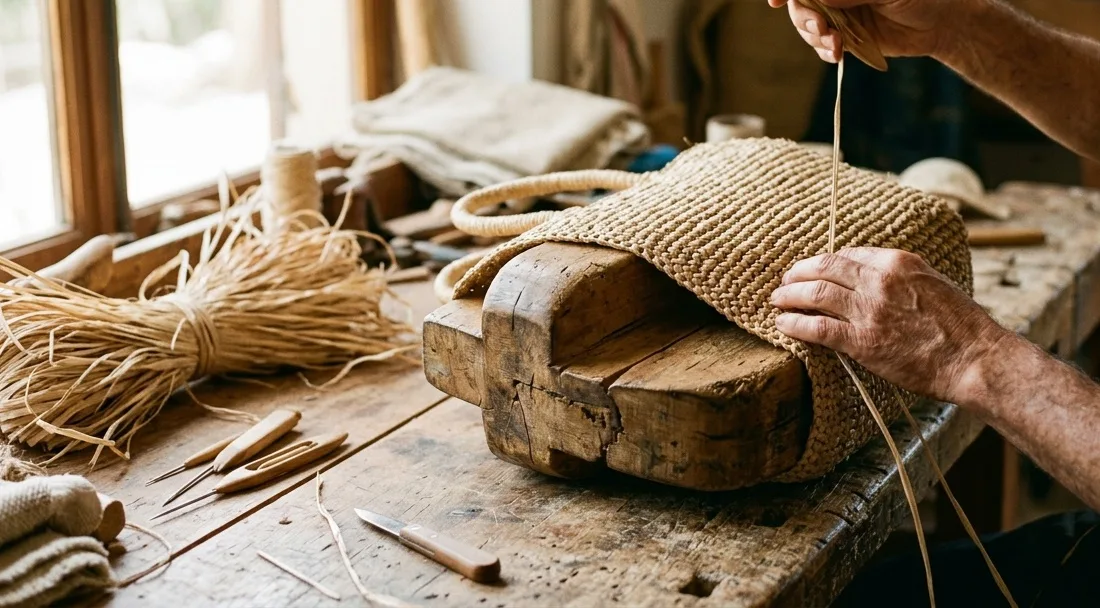 Figure 1: Handcraft in motion — Skilled artisan hands weaving a natural raffia bag over a bespoke wooden blocking mold, ensuring consistent dimensional tension across small batch runs.
Why MOQs Exist in Handwoven Bag Manufacturing
Because authentic handwoven bags—crafted from natural raffia, wheat straw, rattan, and crochet cotton cords—rely on human artisans rather than mechanized assembly lines, buyers often wonder why a handwoven bag MOQ is necessary at all. While an artisan workshop is inherently more agile than a mega-factory, minimum production batches are dictated by four critical upstream constraints:
[Raw Material Dye-Lots] ──► [Artisan Allocation & Weaving Pace] ──► [Tooling & Wooden Molds] ──► [Custom Trims & Hardware]
      (Upstream Mill)                   (Workshop Floor)                    (Carpentry Bench)                (Specialized Foundry)
1. Upstream Raw Material Dye-Lots and Fiber Grading
Natural fibers do not come from synthetic filament rolls; they are harvested organically. Premium Madagascar raffia, for instance, must be manually sorted by strand width and tensile strength before bundling.
When your design requires custom Pantone-matched hues (such as burnt terracotta or sage green), raw fibers must be submerged in temperature-controlled dye vats. Dye mills enforce their own minimum batch runs (typically 50 kg to 100 kg of fiber per vat). Dyeing a tiny 10 kg batch of fiber for a micro-order results in immense chemical waste and heavy raw material surcharges. This is why developing low moq raffia bags in custom colors requires strategic material planning.
2. Artisan Team Allocation and the "Learning Curve" Effect
Handweaving is an art of muscle memory, rhythm, and consistent tension. When an artisan begins weaving a new, intricate openwork pattern, the first three to five units inevitably take significantly longer to produce as the weaver calibrates gauge, handle junction anchors, and dimensional tolerances.
By unit twenty, the artisan has reached peak flow efficiency. If a client order stops at only 15 or 25 pieces, the workshop absorbs maximum learning curve inefficiency without ever reaching the production speed where labor costs stabilize.
3. Wooden Molds and Structural Tooling (Blocking Costs)
To achieve uniform dimensional silhouettes—particularly for structured cylindrical bucket bags, tapered market baskets, and crisp woven tote bags wholesale runs—artisans weave over custom wooden blocking molds (formes de tissage).
These solid wood or composite frames must be hand-carved to your exact technical specifications. Whether you produce 50 units or 1,000 units, the initial mold-making fee and carpentry preparation remain fixed overhead costs. Amortizing that fixed charge over 50 pieces naturally increases the per-unit base cost compared to spreading it over 500 pieces.
4. Custom Hardware and Branded Trim Minimums
Even if an artisan workshop is willing to weave small batches, secondary component suppliers enforce strict industrial minimums:
- Die-cast metal alloy logo plates: Foundry tooling minimums typically start at 100 pieces.
- Custom-woven jacquard neck labels: Narrow-loom textile mills rarely run batches under 500–1,000 labels.
- Debossed leather patches: Cutting dies and hot-stamp embossing setups carry minimum machine run fees.
The MOQ Gradient: Unit Cost vs. Production Lead Time Matrix
Understanding how volume influences your landed costs and delivery milestones allows purchasing managers to select the optimal tier for their brand's cash flow. Below is an operational breakdown illustrating how batch volume alters unit economics and workshop scheduling when developing low MOQ custom bags:
| Production Batch Tier | Primary Strategic Objective | Unit Cost Variance (Relative) | Fixed Overhead Amortization | Customization Depth Feasibility | Typical Production Window |
|---|---|---|---|---|---|
| Starter (50 – 299 pcs / style) |
Low-risk market validation; boutique exclusivity; rapid capsule launch | Highest unit cost (smallest run) | High per-unit share of wooden molds & freight | Stock raw fiber colors; debossed leather labels; stock lining textiles | 30 – 35 days (post-sample approval) |
| Core Business (300 – 999 pcs / style) |
Core seasonal drop; e-commerce restock; boutique wholesale distribution | Tiered volume discounts applied | Well-balanced amortization across batch | Custom Pantone yarn dip-dyeing; custom inner pouch patterns; customized handle drops | 35 – 40 days (post-sample approval) |
| Container Volume (1,000+ pcs / style) |
Broad retail rollout; global resort group procurement; maximum retail margin | Best unit pricing | Overhead fully absorbed; raw fiber volume discounts unlocked | Custom-tooled metal hardware; bespoke woven linings; proprietary weave patterns | 40 – 45 days (dependent on artisan scale) |
| Note: Figures illustrate comparative structural trends across artisan workshops. Final quotations and lead times depend on weave complexity, harvest seasonality, and component availability. |
The Lead Time Paradox: Why Smaller Orders Aren't Always Faster
A common misconception among buyers seeking low MOQ custom bags is that producing 50 handwoven bags takes one-tenth the time of producing 500 bags. In reality, workshop lead times consist of two distinct phases:
- Setup & Material Prep Phase (Fixed: 10–15 Days): Raw fiber sorting, mold carving, custom dye-lot preparation, and counter-sample sign-off occur regardless of volume.
- Weaving & Assembly Phase (Variable: Scales with Artisans): An experienced artisan produces between 1 to 3 complex handwoven bags per day depending on weave density. For a 500-piece order, a workshop simply assigns a dedicated cluster of 10 to 15 coordinated weavers to work concurrently.
Consequently, a 50-piece order might require 30 days, while a 500-piece order might take 45 days—not ten times longer.
4 Practical Strategies to Source Handwoven Bags with Low MOQs
If your business is in a growth phase or testing a new resort category, you do not need to over-leverage your balance sheet. Savvy procurement teams partner with an agile small batch woven bag manufacturer and employ these four tactical strategies to keep MOQs lean while safeguarding gross margins:
┌────────────────────────────────────────────────────────────────────────┐
│               Low-MOQ Procurement Optimization Playbook                │
├──────────────────────────┬─────────────────────────────────────────────┤
│ 1. Fiber Optimization    │ Specify natural undyed raffia & straw bases │
│ 2. Tooling Standardization│ Share one base silhouette across 2-3 SKUs   │
│ 3. Modular Trims         │ Use debossed leather patches over metal mold│
│ 4. Blanket PO Release    │ Commit to seasonal volume; release in waves │
└──────────────────────────┴─────────────────────────────────────────────┘
Strategy 1: Specify Natural, Undyed Raw Fiber Colorways
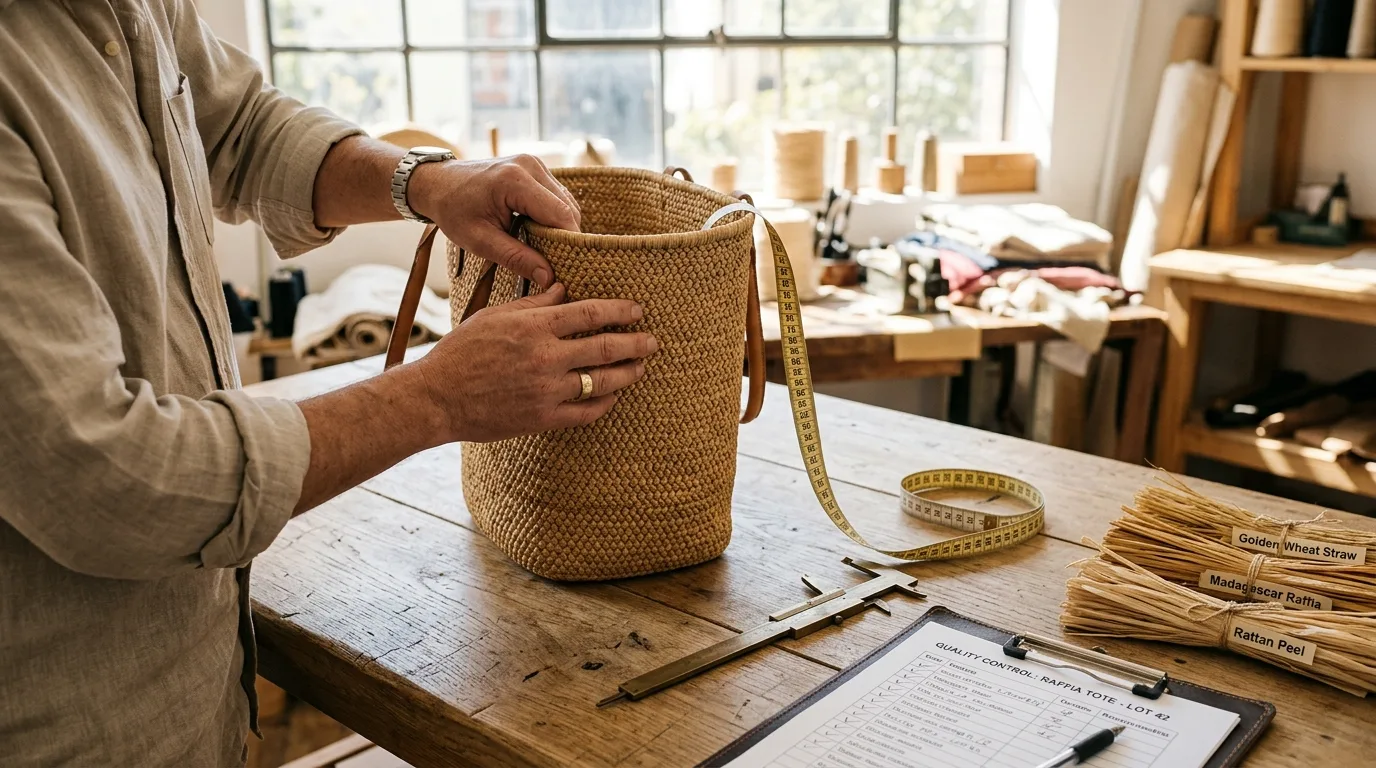
The single biggest barrier to achieving a low handwoven bag MOQ is custom fiber dyeing. Natural, unbleached Madagascar raffia, golden wheat straw, and peeled natural rattan are staples constantly circulating through an active artisan workshop.
By selecting natural fiber tones for the structural body of your bag, you bypass upstream vat-dye minimums altogether. You can easily achieve orders as low as 50 pieces per style for low moq raffia bags when drawing from our baseline raw material inventory.
Strategy 2: Standardize the Core Mold, Differentiate with Linings and Trims
Instead of designing three completely distinct bag silhouettes (which requires three custom wooden blocking molds and separate artisan training curves), standardize one proven architectural silhouette—such as a classic structured bucket bag or an open-top market tote.
You can then create visual variety across your collection through modular accents:
- SKU A: Natural raffia body with French Navy unbleached cotton drawstring lining.
- SKU B: Same natural body with an olive green linen liner and contrast stitching.
- SKU C: Same body featuring an exterior vegetable-tanned leather slip pocket.
This allows the workshop to treat the 150-unit order as a single continuous weaving run on the same mold, granting you volume-tier labor efficiency while delivering multi-SKU diversity to your retail floor.
Strategy 3: Opt for Debossed Leather Patches Over Custom Metal Tooling
Custom zinc alloy or brass metal hardware requires substantial mold charges ($150–$300) and strict foundry batch sizes of 500+ pieces.
To achieve a sophisticated, high-end branded look on custom straw summer bags at low volume, pivot to genuine vegetable-tanned leather labels debossed with your brand wordmark. Leather cutting dies and hot-stamping plates are economical to produce, carry virtually zero waste, and can be hand-stitched directly onto small runs of 50 units with artisanal elegance.
Strategy 4: Negotiate a Blanket Purchase Order with Phased Releases
If your projected seasonal demand is 300 pieces but your working capital prefers smaller inventory batches, discuss a blanket purchase agreement with your manufacturer:
- Phase 1: Contract for 300 units upfront to lock in volume raw material pricing and tooling amortization.
- Phase 2: Authorize an initial delivery of 100 units for your resort launch in April.
- Phase 3: Release the remaining 200 units in two subsequent monthly waves based on sell-through velocity.
This provides the workshop with guaranteed production visibility while giving your brand inventory agility.
Aligning Your Sourcing Stage with NOLVA’s Production Programs
At NOLVA, our manufacturing philosophy rejects the rigid "one-size-fits-all" MOQ model. We operate an agile artisan workshop designed to support brands across every milestone of their retail evolution:
[Testing & Boutique Drops]          [Seasonal Capsule Development]         [High-Volume Distribution]
        50 – 299 pcs                             300 – 999 pcs                           1,000+ pcs
              │                                        │                                       │
              ▼                                        ▼                                       ▼
    Private Label Program                    Custom OEM/ODM Studio                   Bulk Wholesale Tier
(Fast turn, stock fibers, debossed trims) (Custom patterns, dyed raffia, CAD molds) (Maximum margins, container logistics)
1. Market Testing & Boutique Capsules (MOQ: From 50 pcs)
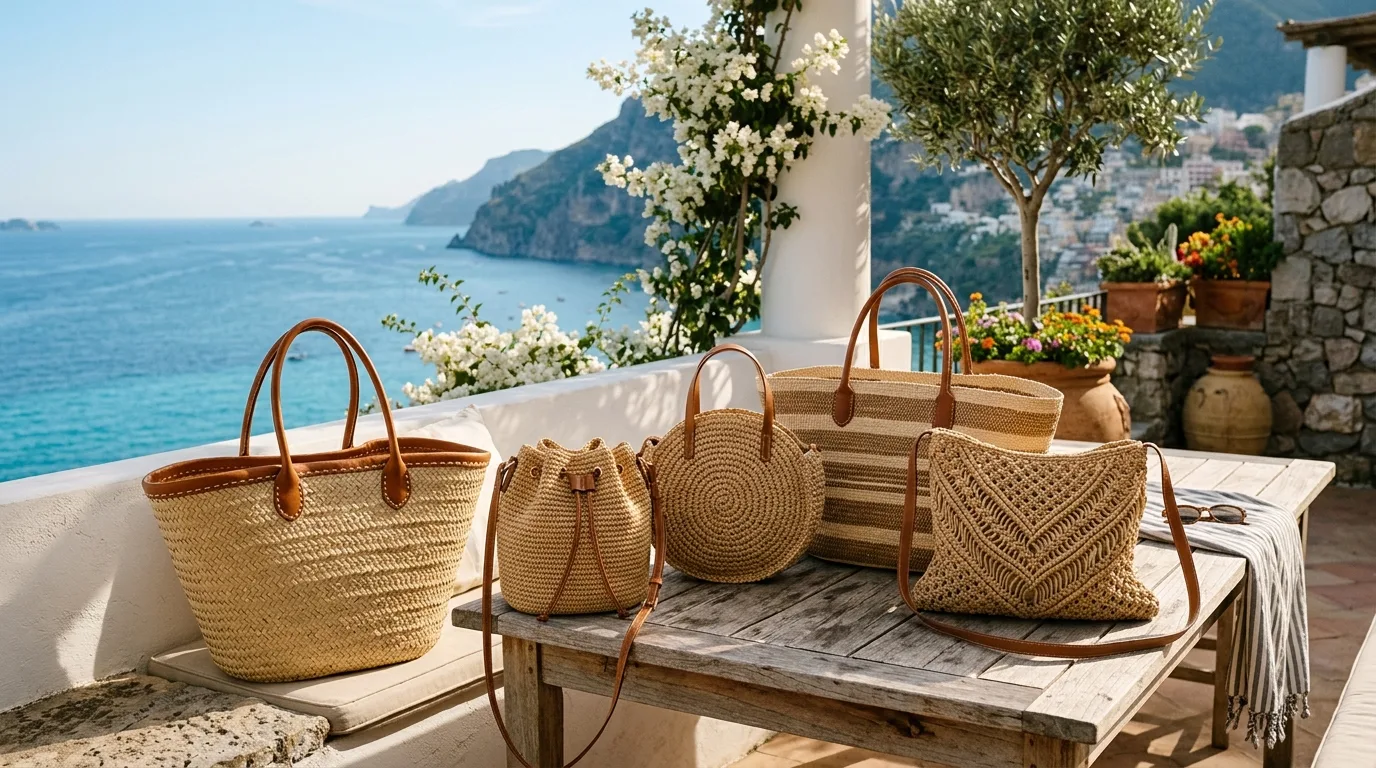
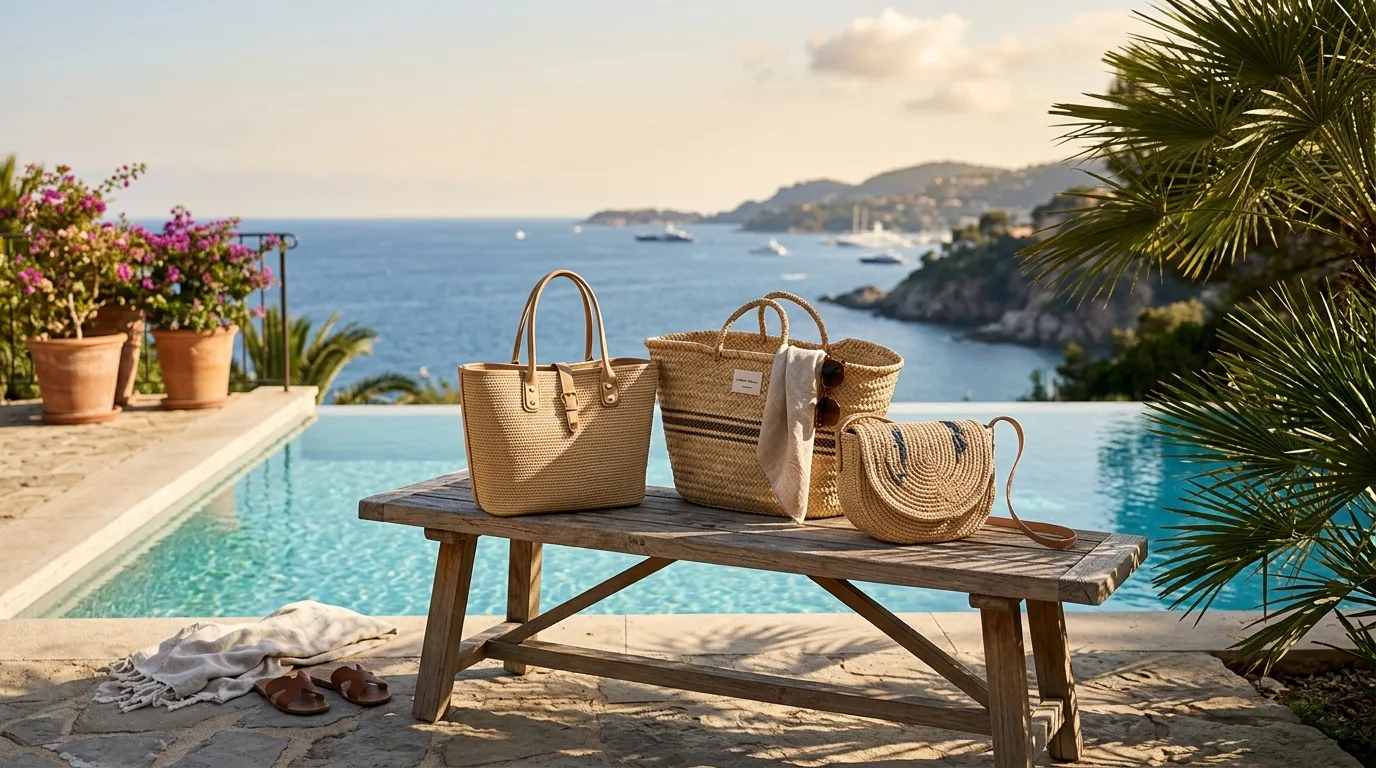
For concept boutiques, hotel luxury gift shops, and emerging designers seeking lean inventory, our flexible private label program provides rapid execution. Select from our catalog of proven market silhouettes—including raffia totes, crochet bucket bags, and straw carryalls—customized with your debossed leather brand tags, bespoke fabric linings, and custom retail packaging.
2. Bespoke Signature Collections (MOQ: 300–999 pcs)
When your design team has developed proprietary CAD sketches, bespoke dimensions, or complex multi-material hybrid designs (such as rattan bodies integrated with leather shoulder harnesses), our custom OEM/ODM development studio manages the complete prototyping journey. We construct dedicated wooden molds, formulate lab-dip color matches, and refine counter-samples to exact commercial tolerances.
3. Volume Wholesale & Hospitality Rollouts (MOQ: 1,000+ pcs)
For established department stores, multi-door retail groups, and international hospitality chains requiring full production runs, explore our bulk wholesale supply program. We provide structured tiered pricing, comprehensive quality assurance audits, standardized carton drop-testing, and coordinated FOB/CIF shipping logistics.
Frequently Asked Questions (FAQ) for Handwoven Bag Buyers
Is "Wholesale Handbags No Minimum Order" a Realistic Sourcing Model?
When buyers search for wholesale handbags no minimum order, they are typically looking at two business models: stock liquidation or drop-shipping from middleman traders. For authentic, artisan-handwoven bags made from natural fibers, true "zero MOQ" does not exist in OEM custom manufacturing. However, partnering with a specialized small batch woven bag manufacturer offering flexible MOQs from 50 pieces delivers the closest practical alternative: you gain bespoke private-label branding, direct factory pricing, and full control over materials without absorbing massive inventory risk.
What Is the Standard Handwoven Bag MOQ for Custom Pantone Dyed Raffia?
Because custom dyeing requires minimum vat-loads at fiber processing mills, custom Pantone-dyed raffia carries a higher minimum than our standard MOQ. If your brand requires a micro-run of 50 pieces, we recommend utilizing our stock natural fiber shades for the body and incorporating custom brand colors via the fabric lining, drawstring ribbons, or leather handles.
Can We Combine Multiple Bag Silhouettes to Meet a Factory MOQ?
Most workshops evaluate MOQ on a per-mold and per-artisan basis. However, if your designs share identical weaving techniques and raw materials (for example, two sizes of the same woven market tote), workshops can frequently negotiate a combined threshold—such as 60 pieces split evenly across two sizes (30 pcs each).
Actionable Buyer’s Checklist: What to Prepare Before Requesting an MOQ Quote
To help our technical workshop team provide an immediate, accurate tiered quotation, prepare the following five specifications before reaching out:
- Target Silhouette & Dimensions: Reference an existing model from our handwoven product collection or provide technical sketches with explicit Height × Width × Depth measurements.
- Primary Fiber & Finish: Indicate whether you require natural undyed raffia/straw or custom Pantone color-matched fibers.
- Handle & Attachment Specifications: Specify handle material (rolled leather, tubular rope, flat weave, bamboo) and attachment mechanism (rivets, hand-tied loops, internal anchors).
- Lining & Security Requirements: Indicate whether the bag requires a loose drawstring pouch, a fixed zip canvas liner, magnetic snaps, or an unlined natural finish.
- Target Delivery Date & Staged Quantities: Share your required arrival window and request tiered pricing for 50, 100, and 300 units to evaluate your capital efficiency.
Ready to explore your upcoming seasonal run? Connect with our master weaving artisans and request a tailored quotation and sampling brief today. Let us transform your design vision into commercial-grade, responsibly crafted handwoven accessories.