B2B-руководство по ценообразованию на плетеные сумки ручной работы. Узнайте, как сорт рафии, трудочасы плетения и объем партии формируют оптовую стоимость.
01 — Почему ценообразование на плетеные сумки удивляет традиционных байеров
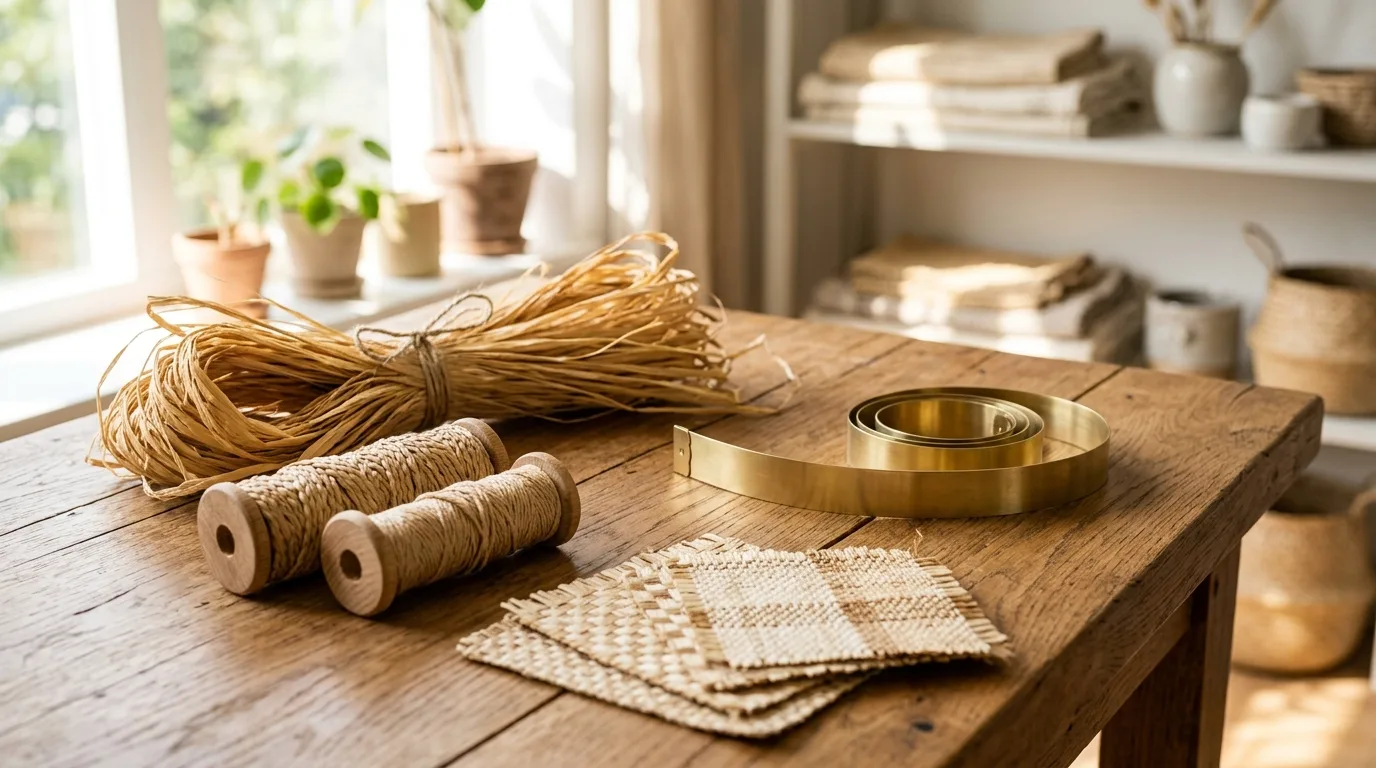 Figure 1: Authentic artisanal atelier setup — raw natural fiber bundles, precision tooling, and sample weave swatches on an artisan's workbench.
For fashion merchandisers, resort boutique buyers, and private label brand founders accustomed to standard cut-and-sew manufacturing, quoting handwoven bags can be baffling. In synthetic leather or canvas production, fabric costs per yard are uniform, cutting dies stamp thousands of identical pieces in minutes, and automated stitching lines produce predictable unit economics.
Handwoven bags operate on an entirely different economic model: organic raw material yield combined with artisan labor-hour accumulation.
When sourcing natural raffia, wheat straw, rattan, or hand-crocheted accessories from China, evaluating a factory quotation requires looking beneath the topline unit price. A $14 FOB quotation and a $24 FOB quotation for seemingly similar straw totes often reflect stark differences in fiber harvest grade, structural longevity, and ethical craft standards.
Understanding this cost breakdown protects your margins, prevents mid-production surcharges, and ensures your brand delivers high-end retail craftsmanship.
02 — 5 ключевых факторов себестоимости сумок ручной работы
Every professional B2B quotation for custom handwoven bags breaks down into five distinct cost centers:
┌────────────────────────────────────────────────────────────────────────┐
│               ANATOMY OF A CUSTOM HANDWOVEN BAG QUOTATION             │
├──────────────────────────┬─────────────────────────────────────────────┤
│ 1. Raw Fiber Grade       │ Natural Madagascar Raffia vs Straw vs Paper │
│ 2. Artisan Weaving Hours │ Skill level, weave tightness & pattern cycle│
│ 3. Structural Tooling    │ Bespoke hardwood molds (formes de tissage)  │
│ 4. Linings & Trims       │ Genuine leather handles, custom hardware    │
│ 5. Export Packaging & QC │ Mold prevention, silica packs, export cartons│
└──────────────────────────┴─────────────────────────────────────────────┘
1. Raw Material Fiber Sourcing & Grading (25% – 35% of Unit Cost)
The foundation of any bag is the natural fiber itself. Fiber costs fluctuate based on origin, harvest season, and processing depth:
- Madagascar Natural Raffia (Raphia Farinifera): The gold standard in luxury summer collections. Raffia leaves are harvested by hand and sun-dried. Grade-A long-strand raffia (1.2m–1.5m strand length) commands premium pricing because it requires fewer splice knots during weaving. Lower grades feature short, brittle strands that lead to loose fiber ends and surface fraying.
- Natural Wheat Straw: Rigid, lustrous, and structurally self-supporting. Raw stalks must be sorted, split, braided into straw plaits, and then stitched or coiled. Costs depend on braid width (3mm ultra-fine plaiting requires significantly more labor than 10mm coarse plaiting).
- Eco-Friendly Paper Straw: A high-consistency engineered cellulose yarn. While lighter and more uniform in dye uptake than wild-harvested grass, premium high-tensile paper yarn treated with water-resistant coatings approaches natural straw in cost.
- Natural Rattan & Reed: Split cane and core rattan require boiling, degreasing, and manual sizing before weaving into rigid basket silhouettes.
2. Manual Weaving Craftsmanship & Labor Hours (30% – 45% of Unit Cost)
Unlike automated textile mills, authentic handwoven bags cannot be accelerated by running machines faster. A single medium-sized intricate raffia bucket bag can require 8 to 16 hours of continuous manual hand-weaving by an experienced artisan.
Key factors that scale labor hours include:
- Weave Density (Knot Count): Tight, micro-gap weaving consumes up to 50% more raw material and doubles artisan working time compared to loose, open-lattice beach weaves.
- Pattern Complexity: Solid plain weave is fastest. Intarsia floral embroidery, chevron jacquard plaiting, or openwork crochet require constant counting and tension recalibration.
- Splice Concealment: Professional artisans tuck and tie off new fiber strands inside the interior wall. Cheaper workshops trim ends haphazardly on the exterior, saving labor but compromising aesthetics.
3. Precision Hardwood Molds & Pre-Production Tooling (Fixed Cost)
To ensure that bag #1 and bag #500 match approved tech-pack dimensions within commercially acceptable tolerances, artisans do not weave in free air. They weave over customized solid hardwood molds (Formes de Tissage).
- Mold Development: Wooden molds are custom-turned by master carpenters to exact CAD specifications (taper angle, base radius, rim circumference).
- Tooling Amortization: A set of custom wooden molds typically ranges from $150 to $350 depending on silhouette complexity. On a 50-piece pilot run, this adds $3.00–$7.00 per unit; on an order of 1,000 pieces, tooling cost amortizes to pennies.
4. Linings, Leather Accents & Metal Hardware (15% – 25% of Unit Cost)
A handwoven exterior requires durable structural accessories to function as a luxury commercial handbag:
- Handles & Straps: Vegetable-tanned genuine cowhide leather handles with hand-painted edge burnishing and saddle stitching provide superior longevity compared to thin bonded PU leather.
- Interior Linings: 10oz unbleached cotton canvas, pure linen, or drawcord pouch closures with metal aglets. The lining must be patterned precisely to match the handmade shell's interior volume without bunching.
- Hardware & Fasteners: High-salinity beach environments require vacuum-electroplated zinc alloy or brass hardware with anti-corrosion clear lacquer coats to prevent tarnishing and rust.
5. Protective Packaging & Export Conditioning (5% – 10% of Unit Cost)
Natural plant fibers absorb moisture from humid marine air during transoceanic shipping. Responsible export packaging includes:
- Conditioning raw fibers to strict moisture levels (10%–13.5% relative humidity) prior to packing.
- Customized shape-retention tissue paper stuffing to prevent transit crushing.
- Micro-perforated breathable polybags and high-capacity food-grade silica desiccant pouches.
- Heavy-duty 5-ply export master cartons with edge corner protectors.
03 — Матрица сравнения затрат по материалам и технологиям
To assist your merchandising team during line planning, the table below compares typical wholesale cost tiers across primary weaving methods:
| Fiber & Technique | Raw Fiber Cost Tier | Labor Intensity | Structural Rigidity | Moisture Sensitivity | Best Suited Brand Positioning |
|---|---|---|---|---|---|
| Madagascar Raffia (Hand-Crochet) | High | High (10–18 hrs) | Soft / Flexible | Low–Moderate | High-End Resort, Designer Boutiques, Premium Fashion |
| Madagascar Raffia (Coiled Basket) | High | Moderate–High | Rigid / Firm | Moderate | Luxury Summer Accessories, Structured Day Bags |
| Natural Wheat Straw (Braided) | Moderate | Moderate (6–10 hrs) | High / Stiff | Moderate–High | Classic Mediterranean Beachwear, Coastal Lifestyle |
| Engineered Paper Straw (Woven) | Moderate | Low–Moderate (4–8 hrs) | Semi-Rigid | Low (Treated) | Contemporary High-Street, Mid-Market Fashion, Gifting |
| Cotton/Linen Blend Crochet | Moderate | High (8–14 hrs) | Ultra-Soft | Low | Bohemian Resort, Casual Summer Totes, Travel Pouches |
04 — Как объем тиража и минимальный заказ (MOQ) влияют на шкалу цен
In handwoven manufacturing, volume economies of scale behave differently than in stamped metal or plastic injection molding. The fiber cost and the artisan's hand-weaving speed remain largely constant.
However, volume significantly reduces costs across four critical bottlenecks:
- Dye Lot Efficiencies: Dyeing natural raffia or straw in 500kg batch vats yields near-zero color variance and reduces dye technician labor per kilogram by up to 60%.
- Mold Duplication: Multiple wooden molds allow simultaneous artisan weaving without waiting for a single mold to clear.
- Hardware & Leather MOQ: Leather tanneries and custom metal buckle casting foundries enforce minimum order quantities (typically 500–1,000 pcs for custom engraved logos).
- Logistics & Customs Amortization: Fixed export documentation, port handling, and container drayage fees are distributed over more units.
┌────────────────────────────────────────────────────────────────────────┐
│                      VOLUME TIERING DYNAMICS                           │
├─────────────────┬──────────────────────┬───────────────────────────────┤
│ Tier 1 (50 pcs) │ Agile Pilot Run      │ Base Cost + Full Mold Amort.  │
│ Tier 2 (300 pcs)│ Capsule Collection   │ 15%–22% Unit Cost Reduction   │
│ Tier 3 (1,000+) │ Full Commercial Run  │ 28%–35% Unit Cost Reduction   │
└─────────────────┴──────────────────────┴───────────────────────────────┘
At NOLVA, we support emerging designer brands with a flexible 50-piece minimum order quantity (MOQ) per style to validate market demand, while providing scaled volume pricing for multi-store retail programs.
05 — Подводные камни закупок: где прячутся скрытые издержки
When auditing competitive supplier quotations, watch out for these three common cost-cutting tactics:
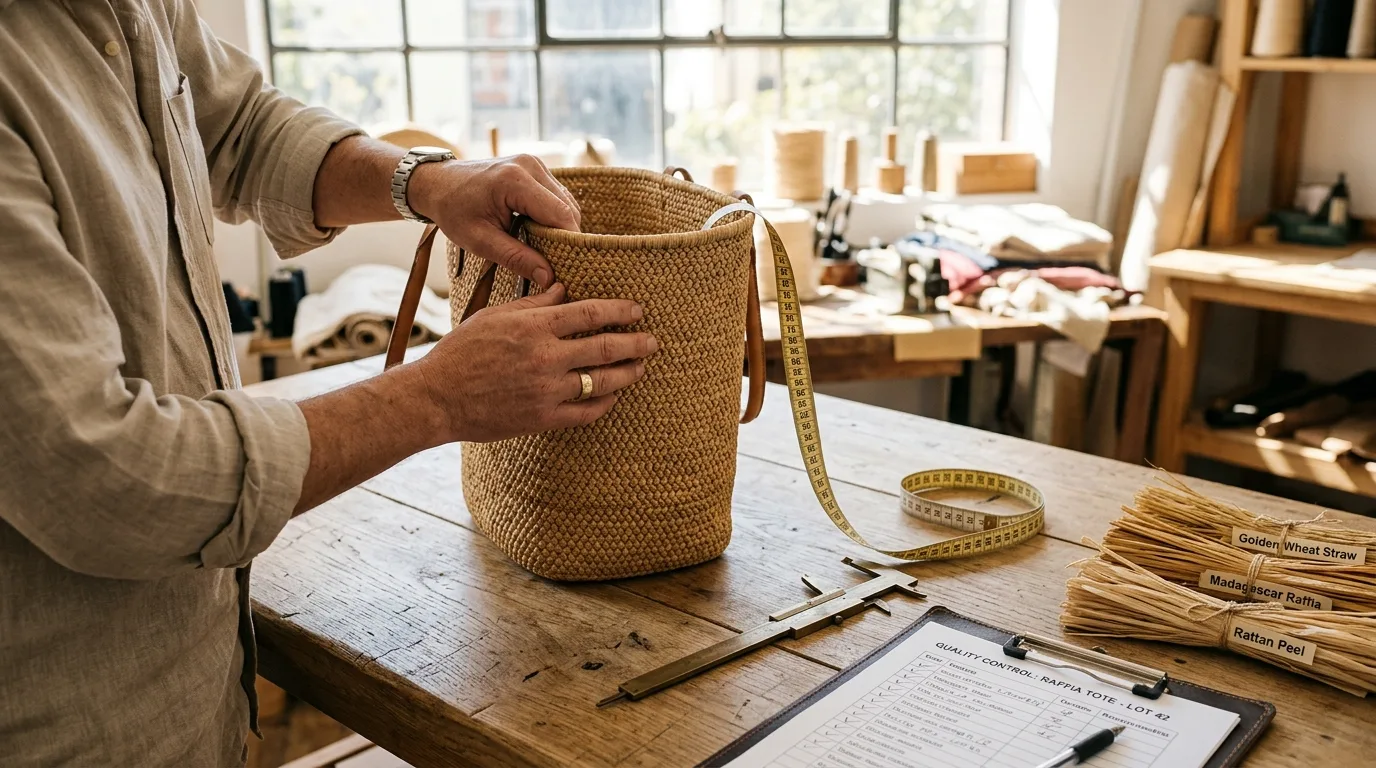 Figure 2: Quality anchor inspection — reinforced dual-saddle stitching connecting genuine leather trim to high-density handwoven raffia.
- Fiber Blending Deception: Quoting for pure Madagascar raffia but substituting lower-cost inland raffia or unplasticized paper straw blends without disclosure.
- Handle Anchor Weakness: Omitting interior leather backing plates. Without internal structural reinforcement, handles anchored directly through natural straw pull through under 3–5 kg of grocery weight.
- Moisture Neglect in Packaging: Cutting corners by omitting desiccant packs or packing wet straw. A container arriving at Rotterdam or Los Angeles with mildewed linings can result in total consignment rejection.
06 — Прозрачный расчет B2B-смет в партнерстве с мануфактурой NOLVA
Navigating handwoven bag production requires a manufacturing partner who balances artisanal mastery with rigorous export engineering.
At NOLVA, our quotation sheets detail every cost component transparently — from fiber origin and wooden mold fabrication to handle leather grade and AQL inspection parameters:
- Custom OEM/ODM Development: Bring your sketches or CAD files to our Custom Handwoven Bag Design Studio. Physical counter-samples delivered in 10–15 business days.
- Low-Risk Private Label Collections: Explore our Private Label Handwoven Bag Catalog. Select proven bestseller silhouettes with custom logo leather debossing and brand hardware starting at 50 pieces per style.
- Volume Wholesale Programs: For department store groups and resort chains requiring container-load scale, access our Wholesale Export Program for tiered volume contracts and door-to-door freight support.
- Explore Current Styles: Review our full range of natural raffia, wheat straw, and crochet styles in the NOLVA Products Catalog.
Request a Detailed B2B Quotation & Craft Consultation from the NOLVA Workshop Team